Sunday, February 11, 2018

Barihunk Alex Esposito featured in two Rossini anniversaries

Alex Esposito
Italian barihunk Alex Esposito will be featured in two Rossini anniversaries within 30 days of each other.

The first will be a (slightly premature) celebration of the 150th anniversary of the composer's death with a performance of his Petite Messe Solennelle. The actual date of death of Rossini is November 13, 1868.

The first will be on February 19 at the Staatsoper Unter den Linden in Berlin, followed by a performance on February 20 with the Berliner Philharmonie. Both casts include soprano Lauren Michelle, countertenor Bejun Mehta and tenor Francesco Demuro under the baton of Marc Minkowski.

Alex Esposito sings "Quoniam tu solus sanctus" from Petite Messe Solennelle:

Petite Messe Solennelle was written in 1863, thirty years after the composer's official retirement and thirty-four years after his last opera. The piece was originally composed for twelve singers (four of them soloists), two pianos and harmonium, but he later created an orchestral version. That version was never performed in his lifetime because he could not obtain permission to perform it with female singers in a church.

The bass solo aria in the piece is "Quoniam tu solus sanctus" (For You alone are Holy) from the Gloria, which after a short introduction, marked adagio, leads to an extended section, marked Allegro moderato with contrasts in dynamics.

Esposito has also recorded Petite Messe Solennelle with Antonio Pappano and the Orchestra dell'Accademia Nazionale di Santa Cecilia.

Alex Esposito sings "Cade dal ciglio" from Mosè in Egitto:

Esposito will then head to the Teatro di San Carlo in Naples for the 200th anniversary of Rossini's Mosè in Egitto, which premiered at the theater on March 5, 1818. He will perform the role of the Pharoah. There will be four performances between March 15-20 and the cast includes hunkentenor Enea Scala as Osiride and barihunk Mirco Palazzi as Mosè, for the March 17th performance. The Barihunks team will be in attendance! Tickets and additional cast information is available online.

The opera is loosely based on the Exodus from Egypt of the Israelites led by Moses. It opens as the plague of darkness is dispelled by Moses' prayer, and it ends with the spectacle of the parting of the Red Sea and the drowning of Pharaoh's host. Billed in 1818 as an azione tragico-sacra, the sacred drama with some features of the oratorio circumvented proscriptions of secular dramatic performances during Lent.

Rossini slightly revised the opera in 1819, when he introduced Moses' prayer-aria "Dal tuo stellato soglio", which became one of the most popular opera pieces of the day and which inspired a set of variations for violin and piano by Niccolò Paganini.

Mirco Palazzi and Enea Scala
The opera has only had sporadic performances outside of Italy and France. In the U.K. it was performed for 142 years after its premiere in 1822, and then not revived again until 1994. The Welsh National Opera staged it again in 2014 in Cardiff and on tour. This is the production that will be seen in Naples next month.

In the U.S., Mosè in Egitto had not been heard in Chicago since 1865, but it was presented in that city by the Chicago Opera Theater in 2010 and subsequently by the New York City Opera in April 2013.

In 1827 Rossini revised the work with a new title, Moïse et Pharaon, ou Le passage de la Mer Rouge for performances in his adopted home of Paris. 

Mike Nyby to sing first Scarpia with Opera Ithaca

Mike Nyby
Canadian Mike Nyby will be making his role debut as the evil police chief Scarpia in Puccini's Tosca with Opera Ithaca. Nyby will be replacing fellow barihunk Zachary James, who had to withdraw for personal reasons. Nyby has previously performed with the company as Demetrio in Kristin Hevner Wyatt's Il Sogno and as Falke in Johann Strauss' Die Fledermaus.

Jake Stamatis (Photo: Joshua Bernard)
The cast also includes barihunk Jake Stamatis as Angelotti, Megan Nielsen as Floria Tosca and Paola Buffagni as Mario Cavaradossi. The semi-staged production will be performed at the Community School of Music & Arts in Ithaca on February 16th and at the Lafayette Avenue Presbyterian Church in Brooklyn on February 18th. Tickets and additional cast information is available online.

This is Nyby's fourth Puccini role, have previously performed Pinellino in Gianni Schicchi and both Schaunard and Marcello in La bohème. This is a homecoming of sorts for Nyby, who graduated from Ithaca College with a Bachelor of Music.

Wednesday, January 31, 2018

BariToned part of Valentine's Day double-header

BariToned
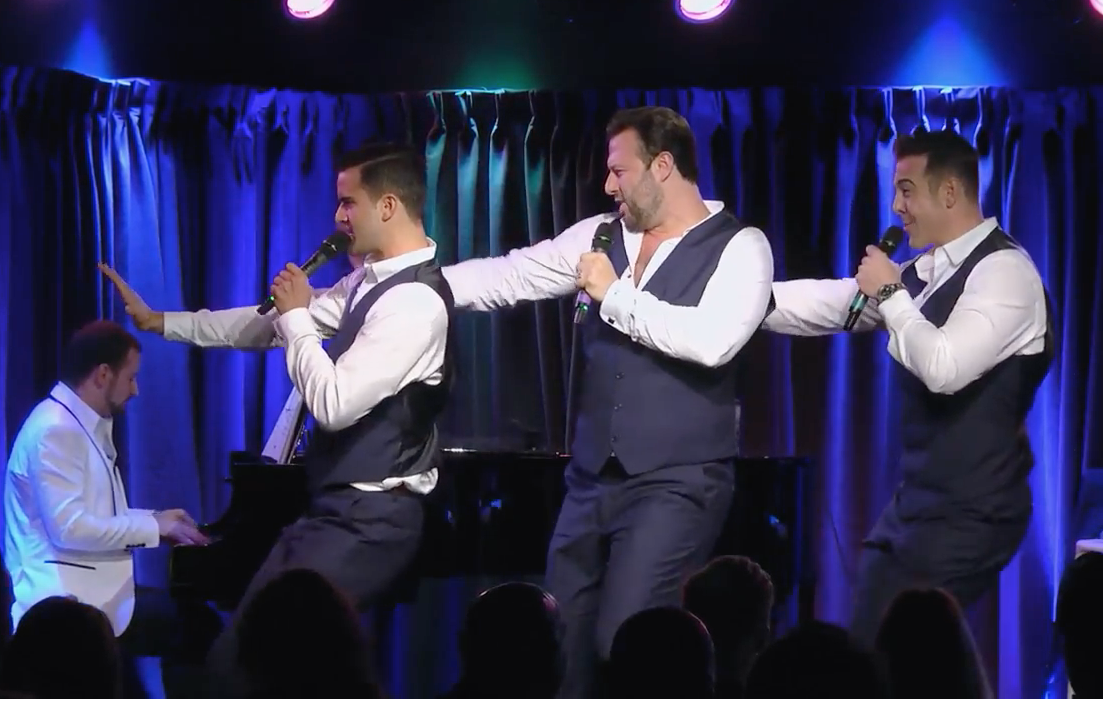
BariToned, the popular trio of big, brawny, beautiful men, which includes Joe Hager, Edward Miskie and Caleb Albert, will be part of a double-header, post-Valentine's Day concert at The Green Room 42 in New York City on February 15th. 

The concert will start with "Always Andrews - A Musical Tribute to the Andrews Sisters," which celebrates the music and comedy of the legendary WWII-era trio of singing sisters. BariToned will then perform some of their songs from their "I Hate Men" show, including Bring On The Men, That'll Show Him, Wash That Man Right Out Of My Hair, What You Don't Know About Women, Back To Before, and I Hate Men.

Tickets are $20 and are available online. 

BariToned
Miskie is a New York-based Pennsylvania native who has performed Julian Marsh in 42nd Street, Cinderella's Prince/The Wolf in Into The Woods, Fred Graham in Kiss Me Kate, Adam Pontipee in Seven Brides for Seven Brothers, and many more. We recently posted about his book "Cancer, Musical Theatre, and Other Chronic Illnesses" which is available on Amazon and Kindle.  


Joe Hager is a New York-based Kansas native who has performed Dennis Dupree in Rock of Ages with Norwegian Cruise Lines for the last seven years. Additional credits include the National Tour of Beauty and the Beast as Gaston, the international tour of Phantom of the Opera as Monsieur Richard,  Tom MacKennle in the Seven Year Itch at the York Theatre. Additional credits include Javert in Les Miserables at the Palace Theatre, Sky Masterson in Guys & Dolls at the Metropolitan Ensemble Theatre, Macheath in The Three Penny Opera at the Brevard Music Center, and Marcello in La boheme at Hidden Valley Opera.
 
Caleb Albert grew up on the family farm in Calvert, Pennsylvania and graduated with a BFA in Music Theatre from Elon University. He has performed with Kings Dominion and Flat Rock Playhouse, as well as appearing in MT '17's Diva Cabaret, and Elon Cares: Broadway's Equity Fights AIDS.

Uprorious "The Pearls of Cleopatra" returns to Berlin

Dominik Köninger and Dagmar Manzel
Director Barrie Kosky's hilarious and highly entertaing The Pearls of Cleopatra (Die Perlen der Cleopatra) by Oscar Straus is back at the Komische Oper in Berlin. The piece was on the shelves for more than eighty years before it was revived in 2016. The latest run features almost the identical cast, led by German barihunk Dominik Köninger, who sings the role of the Roman Officer and appears in a number of pretty sexy situations throughout the operetta.


Kosky has been reviving works by composers who fled the Nazis, which Strauss did in 1939 following the Nazi Anschluss. He fled to Paris and eventually to Hollywood. After the war, he returned to Europe, and settled at Bad Ischl, where he died.  Straus' best-known works are Ein Walzertraum (A Waltz Dream), and The Chocolate Soldier (Der tapfere Soldat). He may be best remembered for composing the theme song from the 1950 film La Ronde.


In the comedic The Pearls of Cleopatra, the queen longs for a ‘little Egyptian flirting’ to lift her mood. The permanent drought and the armies of the Roman Empire at the Egyptian borders have given her quite a headache. So she flirts with the Syrian prince Beladonis and takes Silvius, the Roman ambassador, as her new lover. International or intimate relations – the most beautiful queen of the world holds sway over the hearts of all men. Could the pearls be the secret to her power. 


The Pearls of Cleopatra features plenty of scantily clad, energetic performers on stage, adding to the lively Cabaret feel of the pre-Nazi Weimar Republic. The operetta opens on January 31st and runs through March 30th. Tickets are available online. Opening night is SOLD OUT.

You can now support Barihunks by donating at Patreon. 

Saturday, January 27, 2018

Herzlichen Glückwunsch zum Geburtstag, Wolfgang Amadeus Mozart!

What could we possibly say about Mozart that either hasn't been said or you don't know already? Born on January 27, 1756, he was a child prodigy, who wrote his first symphony when he was eight years old and his first opera at age twelve. He went on to write some of the most important masterpieces of the Classical era, including symphonies, operas, string quartets and piano music. Of course, he has been an endless source of material for Barihunks, especially his operas Don Giovanni, Le nozze di Figaro and Cosi fan tutte, which provide us with an ongoing stream of sexy low voices.

We think the best way to celebrate his birthday is with some music from our favorite singers:

Aaron Sørensen sings Mozart's "Alcandro, lo confesso"

Erwin Schrott sings the Catalog aria:

Cesare Siepi sings "Per questa bella mano":

Rod Gilfry and Liliana Nikiteanu sing "La ci darem la mano"

Monday, January 22, 2018

Paul La Rosa in tango opera Maria de Buenos Aires

Paul La Rosa rehearsing Maria de Buenos Aires in San Diego (Photo: Angel Mannion)
Barihunk Paul La Rosa will taking on the role of El Payador (the gaucho minstrel) in Astor Piazzolla's tango infused opera Maria de Buenos Aires. The San Diego Opera is presenting four performances of the increasingly popular piece between January 26-28, with a 7 PM and 10 PM curtain on the 27th. Tickets are available online.

The opera will be directed by John de los Santos, who has directed the piece throughout the country, and will direct it again with barihunk Luis Alejandro Orozco at the Fort Worth Opera Festival from April 27 and May 5. Paul La Rosa's tango partner will be soprano Aubrey Babcock.

The opera opens with Duende (the Narrator) who relates the story of Maria, a prostitute born in the slums “one day when God was drunk … with a curse in her voice.” Maria is seduced by the rhythms of the tango and soon becomes “the most sorcerous singer and lover” in Buenos Aires. However, her “fatal passion” arouses the wrath of robbers and brothel madams who shoot her to death, and bury her in an unmarked grave. In death, Maria is pulled into a dreamlike Hell where she encounters the choral circus of psychoanalysts who dissect her to the core. She makes a resurrection of sorts when the Duende summons her to return as a Shadow, give birth to a new Maria, and haunt the sordid streets of Buenos Aires which she once walked.

Director John de los Santos talks about Maria de Buenos Aires:


Unlike most who contributed to the origins and development of the tango, Piazzolla came from a different background. He was a classically trained, refined musician and composer. Piazzolla undoubtedly made tango available to a wider audience and helped extend its boundaries, both stylistically and geographically. For that, he was equally admired and criticized, but it is almost universally recognized that Piazzolla’s style lent tango worldwide cultural legitimacy, even in what is known as the realm of “classical” music.

Besides being an extraordinarily talented composer, he was also an exceptional bandoneon player. Piazzolla drew from classical and contemporary sources as well as from the deep roots of tango, creating a powerful synthesis that propelled it from being in some regards a thing of the past to a contemporary language, reinvigorating the style.

Sunday, January 21, 2018

Andrew Garland featured in world premiere of Holocaust opera

Andrew Garland
American barihunk Andrew Garland will sing Abe in the world premiere of Gerald Cohen and Deborah Brevoort's opera Steal a Pencil for Me with Opera Colorado, which opens on January 25th and runs through January 30th. Tickets are available online.

The opera is a true story about a group of Dutch Jews who are deported to Bergen-Belsen concentration camp in the last year of World War II. Surrounded by horrors of the Holocaust, Jaap and Manja Polak’s already fragile marriage dissolves as he turns his attentions to Ina Soep. The couple struggles to survive at the Bergen-Belsen concentration camp, while surrounded by torture, disease, starvation, and death. The secret lovers exchange passionate letters written with stolen pencil stubs, keeping their hopes and hearts alive in a time of  darkness.

Andrew Garland sings The Gallows Tree:

In a happy ending to the real life story, Jaap and Ina Polak stayed married for 70 years after surviving the horrors of the concentration camp!

The Massachusetts native moved to Colorado last year to join the voice faculty at the University of Colorado at Boulder. In February, Garland will join Camerata Pacifica for a series of lieder recitals in California with accompanist Warren Jones in Ventura, San Marino and Santa Barbara.