Barihunk Zachary Gordin has worn many hats in his operatic career, from teacher, coach, manager and, of course, singer. His latest endeavor will be as Artistic Director of Festival Opera in the San Francisco Bay Area.
The company was founded in 1991 by Arizona Opera co-founder Dr. Theodore Weis and has had a rich and occasionally rocky history, including the West Coast premiere of Ned Rorem's Our Town and a highly acclaimed Star Wars-themed production of Mozart's Abduction from the Seraglio.
Gordin's first season will include a fully staged production of Carlisle Floyd's American masterpiece Susannah. The opera will feature soprano Shana Blake Hill in the title role, tenor Alex Boyer as Sam, baritone Philip Skinner as Reverend Olin Blitch and baritone Eugene Brancoveanu as Elder McLean. Gordin has even imported German bass-baritone Malte Roesner for the role of Elder Ott. Roesner made his acclaimed 2017 American debut down the road with West Edge Opera in Vicente Martin y Soler's The Chastity Tree. This will be Roesner's debut with the company.
Malte Roesner
Gordin will kick off the season himself in a recital with his frequent collaborator Brian Nies on May 28. The duo will perform Schumann’s Dichterliebe, along with songs by Jake Heggie, Reynaldo Hahn,
and Ralph Vaughan Williams. The two released an album of Hahn songs in 2017 called “Amour sans
ailes,” which was was named Best Lieder
Recording of 2017 by Voix des Arts.
Gordin previously performed with the company as Angelotti in Puccini's Tosca, Escamillo in Bizet's Carmen, Enrico in Donizetti's Lucia di
Lammermoor, Germont in Verdi's La traviata and Joseph De Rocher in Jake Heggie’s Dead Man
Walking.
Tickets for the recital and Susannah are available ONLINE.
There are a number of composers who have had an amazing gift for writing
for the baritone voice. In an earlier era, Verdi, Wagner, Poulenc and
Carl Loewe all wrote timeless music for baritones. In contemporary
times, Jake Heggie, Ricky Ian Gordon and Clint Borzoni have kept the tradition alive, with all three writing baritone leads for almost every new opera.
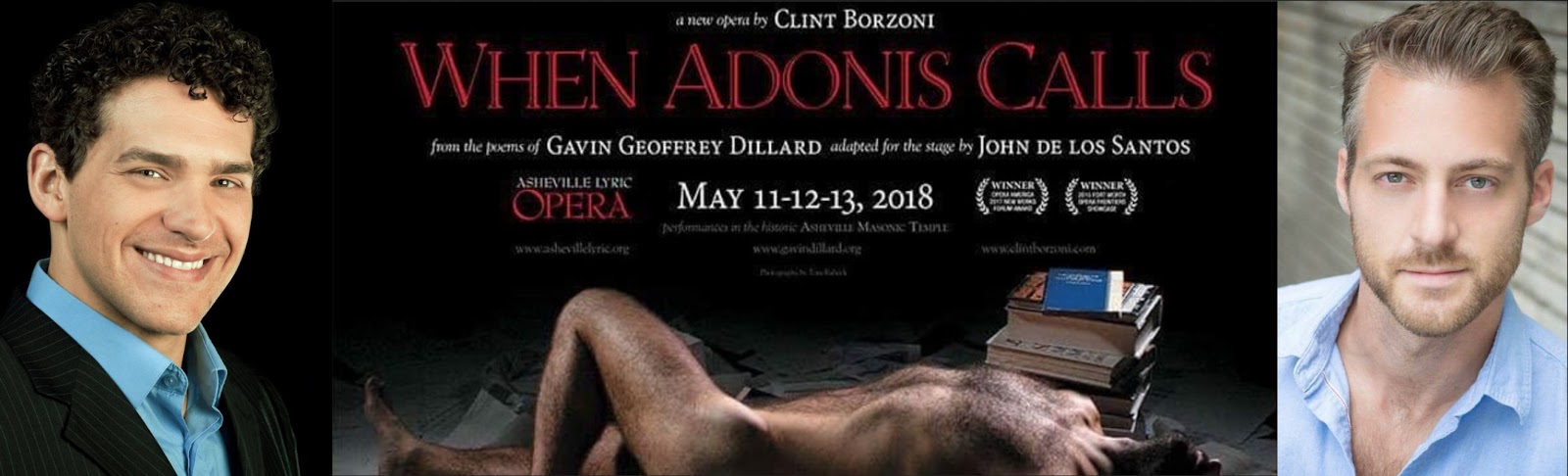
Borzoni's latest opera, When Adonis Calls," which debuted on May 11, 2018 at the Asheville Lyric Opera is written for for bass-baritone and baritone, string quartet, percussion and two dancers. The opera already has second performance scheduled in
Chicago with the Thompson Street Opera Company this Fall and discussions are underway for
a West Coast premiere next year.
Marco Vassalli sings Clint Borzoni's "Stüfen" with Musica Marin:
Borzoni, who is the Composer-in-Residence at Musica Marin, has written highly acclaimed music low male voice. For those on the West Coast, you'll be able to enjoy his latest song cycle "The Hidden Singer," written for German bass Malte Roesner and string quartet. The cycle revolves around seven poems by Wendell Berry all
associated with birds,
which are normally correlated with high soprano voices. The piece will debut on June 3, 2018 with Musica Marin at the historic Ansel Adams home in San Francisco. Tickets are available online. The song cycle will be paired with
Mendelssohn's String Quartet in A minor.
Randal Turner sings Clint Borzoni's "I Dream'd in a Dream"
Borzoni has written another song
cycle for bass-baritone Tim
Hill, several songs for bass-baritone Randal Turner (based on Walt Whitman's poetry) and penned two pieces
for String Quartet and baritone for Marco Vassalli based on German settings. He also wrote the
two-act opera “Antinous and Hadrian,”
which features a baritone lead. His opera The Copper Queen, won Arizona Opera's Sparks Competition
for new works, and is based on a true story about the
alleged ghost of a prostitute haunting a historic hotel in Bisbee,
Arizona.
Joshua Jeremiah and Trevor Martin(photo: Frank Zipperer)
The Asheville Lyric Opera has a huge success on its hands and bragging rights for landing the highly anticipated world premiere
of composer Clint Borzoni and librettist John de los Santos' "When Adonis Calls," which debuted on May 11th. There are additional performances on May 12 and 13. Asheville is also the home of Gavin Geoffrey Dillard, whose poetry was refashioned into the libretto. Tickets are available online.
Joshua Jeremiah and Trevor Martin(photo: Frank Zipperer)
The opera, which was work-shopped at the Fort Worth Opera Festival's
Frontiers series of new works in 2015, chronicles the tale of a distant relationship between an accomplished, if aging and discouraged Poet an a young, inspired, and impetuous Muse. Two male dancers create the emotional subtext as the poets banter back and forth of their loves, their animosities, their jealousies, and their creative furies.
Trevor Martin(photo: Frank Zipperer)
The piece is scored for two baritones, string quartet, percussionist and two dancers (and comes with an adult content warning). When Adonis Calls features
a low and high baritone, and Asheville Lyric Opera featured two
amazing performers in Trevor Martin and Joshua Jeremiah, as well as two
local dancers.
Joshua Jeremiah and Trevor Martin and dancers(photo: Frank Zipperer)
"When Adonis Calls" already has a second performance scheduled in
Chicago with the Thompson Street Opera Company this Fall. Details are
forthcoming. Our site has also learned that discussions are underway for
a West Coast premiere.
Malte Roesner(Photo: Jack Michaels)
For those on the West Coast, you'll have an opportunity to experience another world premiere from Clint Borzoni, when German bass Malte Roesner premieres the song cycle "The Hidden Singer, " based on the poetry of Wendell Berry. The cycle revolves around seven poems all associated with birds,
which are normally correlated with high soprano voices. The song cycle is scored for string
quartet, but opens with an a cappella setting.
The concert will be held at Ansel Adams' former home in San Francisco
and tickets include a generous supply of wine and food, in keeping with
Musica Marin's tradition to present chamber music in the original
intimate, salon setting of a home. The song cycle will be paired with
Mendelssohn's String Quartet in A minor. Tickets for the June 3rd
concert are available online.
German bass Malte Roesner, who was born in the United States, will be premiering a quintessentially American song cycle by Clint Borzoni, based on the poetry of Wendell Berry. The cycle, which is entitled "The Hidden Singer" revolves around seven poems all associated with birds, which are normally correlated with high soprano voices. The low, male voice works well with Berry's settings, who has been dubbed the "conservationist poet," and Borzoni's music grounds these works solidly in nature and the Earth around us. The song cycle is scored for string quartet, but opens with an a cappella setting.
Randal Turner sings Borzoni's "That shadow, my likeness":
The concert will be held at Ansel Adams' former home in San Francisco and tickets include a generous supply of wine and food, in keeping with Musica Marin's tradition to present chamber music in the original intimate, salon setting of a home. The song cycle will be paired with Mendelssohn's String Quartet in A minor. Tickets for the June 3rd concert are available online.
The song cycle was commissioned specifically for Roesner, and Borzoni said that he learned a lot from working directly with the singer, who is also a musicologist and recently transitioned to a lower voice range.
We asked Malte Roesner to tell us about this song cycle and here's what he had to say:
"Artistic expression can speak to us on many different levels. It can be emotionally beguiling or intellectually stimulating or aesthetically pleasing. Only exceptional art has the ability to reach us on all of them simultaneously. The same way that multi-sensory learning is the most effective way of understanding or memorizing something, I think that this multi-level impact is what makes art captivating.
The poems by Wendell Berry do have this quality. They are modern poems, but they are also timeless through their imagery of nature and metaphor and in their deeply spiritual sense of connectedness.
We are very lucky that in this song cycle Clint was not only able to capture these qualities and feelings, but augment them by adding his own artistic depth. Either this is just a very lucky pairing or Clint has shown an exceptional sensibility when writing this music (probably both), because I feel that his composition possesses the same timelessness and captivating visceral quality as the poems.
There is an earthy and "woody" feeling to the music, yet it washes over you like water. At other times there are almost folkish elements that dance with an aerial lightness. And I am sure I could also describe a fiery quality in order to cover ALL the alchemistic elements...There is not a lot of art song literature written specifically for the bass voice, maybe because this voice type functions a little bit differently than high voices or because it feels as if it only lends itself for very specific topics. I feel that this song cycle is a truly special and important addition to the bass song repertory, because it just... works... and then gets you in the feels."
Borzoni, who is the Composer-in-Residence at Musica Marin, has become associated for writing for low male voice. He has written a song
cycle for bass-baritone Tim
Hill, several songs for bass-baritone Randal Turner (based on Walt Whitman's poetry) and penned two pieces
for String Quartet and baritone for Marco Vassalli based on German settings. His opera "When Adonis Calls," which is scored for baritone and bass-baritone, is receiving performances in both Asheville and Chicago this year. He also wrote the two-act opera “Antinous and Hadrian,”
which features a baritone lead. His opera The Copper Queen, won Arizona Opera's Sparks Competition
for new works, and is based on a true story about the
alleged ghost of a prostitute haunting a historic hotel in Bisbee,
Arizona.
Marco Vassalli sings Borzoni's "Stufen":
Roesner made his highly-acclaimed U.S. stage debut last year with West Edge Opera in Soler's The Chastity Tree, as well as his recital debut performing music by Soler and Süßmayr. He recently performed the Devil in Weinberger's Schwanda, der Dudelsackpfeifer (Schwanda, the Bagpiper) at the Stadttheater Gießen in Germany.
We've always maintained that the smaller houses and festivals are where the best new operas are being performed. So kudos to the Asheville Lyric Opera for landing the highly anticipated world premiere of composer Clint Borzoni and librettist John de los Santos' "When Adonis Calls" on May 11th. Asheville is also the home of Gavin Geoffrey Dillard, whose poetry was refashioned into the libretto.
The opera, which was work-shopped at the Fort Worth Opera Festival's Frontiers series of new works in 2015, chronicles the tumultuous correspondence between an established writer and an eager young admirer.
"Two Nooses" from the Fort Worth Opera Festival
The piece is scored for two baritones, string quartet, percussionist and two dancers (and comes with an adult content warning). When Adonis Calls features a low and high baritone, and Asheville Lyric Opera will feature two amazing performers in Trevor Martin and Joshua Jeremiah, as well as two local dancers. The opera will have additional performances on March 12 and 13 and is expected to sell out in the 110 seat Masonic Temple. Tickets are available online.
Composers and opera administrators will tell you that a second performance of a work is often more difficult than the premiere. Remarkably, Adonis already has a second performance scheduled in Chicago with the Thompson Street Opera Company this Fall. Details are forthcoming. Our site has also learned that discussions are underway for a West Coast premiere.
Marco Vassalli sings Clint Borzoni's beautiful "Stufen" with Musica Marin:
Borzoni, along with Jake Heggie, has become particularly associated for writing major roles and works for low male voices. He has written a song cycle for bass-baritone Tim
Hill, several songs for bass-baritone Randal Turner, penned two pieces for String Quartet and baritone for Marco Vassalli, and is currently working on a commission for bass Malte Roesner to be premiered at Musica Marin this year. Turner’s songs
appear on his CD, “Living American Composers” and were performed at the 9/11 tribute at the U.S. embassy in Switzerland. He also wrote a two act opera titled “Antinous and Hadrian,” which features a baritone lead. His opera The Copper Queen, also to a libretto by John de los Santos, won Arizona Opera's Sparks Competition for new works in a runaway. The opera is based on a true story about the alleged ghost of a prostitute haunting a historic hotel in Bisbee, Arizona.
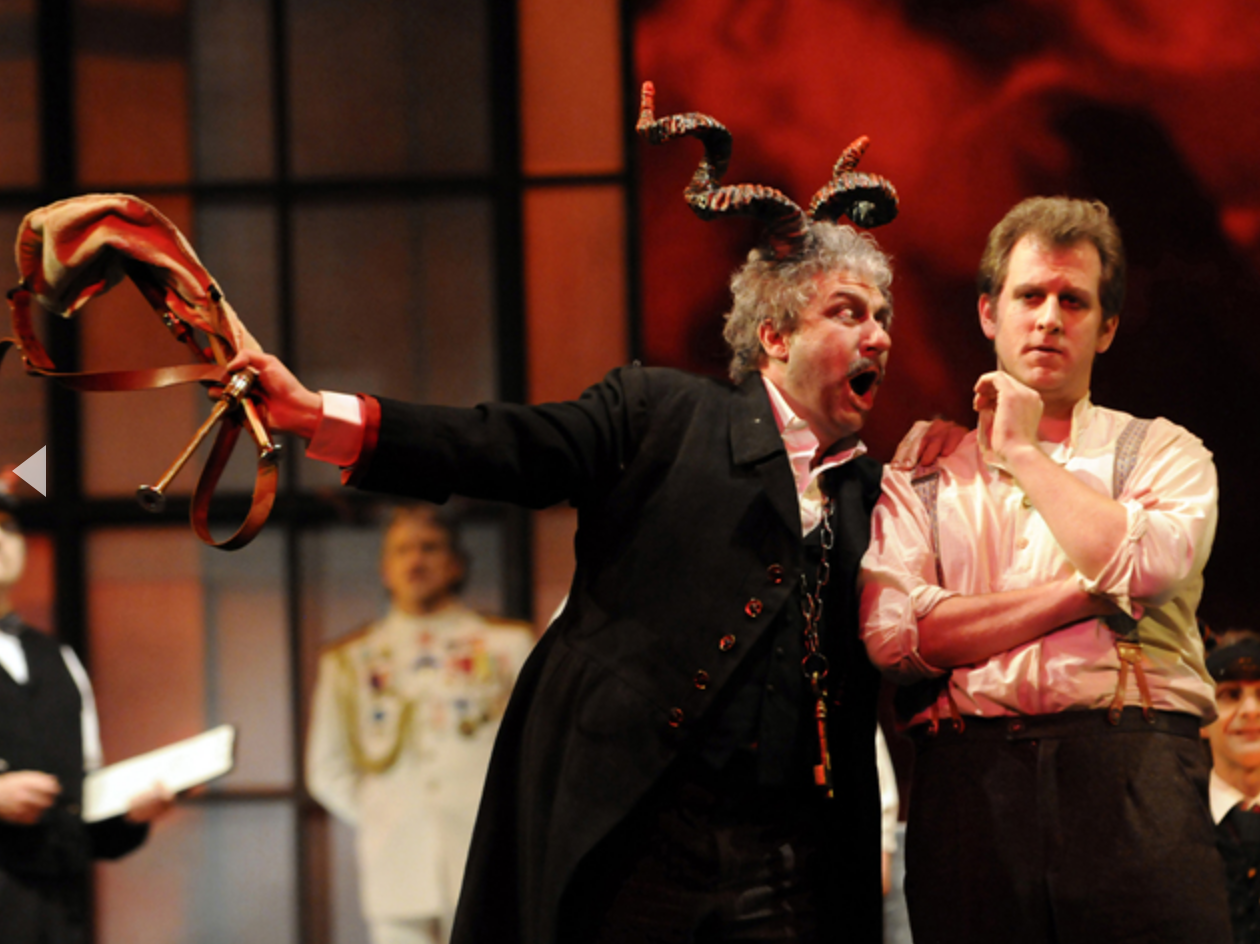
On March 18th, bass-barihunk Malte Roesner will appear as the Devil in Jaromír Weinberger's rarely performed Schwanda the Bagpiper (Švanda dudák) at the Stadttheater Gießen. The opera, which has been translated into 17 languages, will be performed in its more common German translation as Scwhanda, der Dudelsackpfeiffer. Tickets and additional cast information is available online.
The two act opera was written in 1926 to a Czech libretto by Miloš Kareš and is based on the drama Strakonický dudák aneb Hody divých žen (The Bagpiper of Strakonice) by Josef Kajetán Tyl, who was a leading figure in the Czech National Revival movement. Schwanda the Bagpiper became highly successful after its
premiere, with over 2,000 performances, including at the Metropolitan
Opera in 1931 with a cast that included the legendary Friedrich Schorr
in the title role and the great Wagnerian contralto Karin Branzell as
Queen Iceheart.
The opera fell from the repertory when the composer's music was banned
by the Nazi regimes of Austria and Germany during the late 1930s
Michael Eder and Christoph Pohl in Dresden's Schwanda
Jaromír Weinberger (1896-1967) was a Czech born composer, who was naturalized as an American citizen in 1948. He was born into an Austria-Hungarian family of Jewish origin. In 1922, he moved to the United States where he taught at Cornell University and was professor of composition at was is now Ithaca College. During the 1950s, Weinberger moved to St. Petersburg, Florida. In later
life, he developed cancer of the brain. This, together with money
worries and the neglect of his music, prompted him to take a lethal
sedative overdose in August 1967.
The opera tells the fantastical story of a simple farmer who is a notoriously gifted bagpiper. He and his wife are visited by a thief, Babinski, who is on the run. His tales of adventure lure Schwanda to agree to play his pipes for a mysterious Queen vexed with melancholy. Happy again, her spell broken, she proposes to Schwanda, who agrees and gives her a kiss. The original wife arrives and is understandably unhappy, and Schwanda swears that if he kissed the Queen, he would go directly to hell. Hell obliges, of course, and there Schwanda is tricked into giving the Devil his soul. The thief Babinski then arrives to save the day, bringing Schwanda his pipes, beating the Devil at cards, and trading his winnings for Schwanda’s soul and triumphant release.
The "Polka and Fugue"from the opera are often heard on symphony concert programs.
Malte Roesner, who earlier
this year made his U.S. stage debut with West Edge Opera in Vicente Martín y
Soler's The Chastity Tree (see our post), as well as his U.S. concert debut,
is returning on December 10th for a recital at San Francisco's historic Palace
of the Legion of Honor. The concert is a collaboration with Opera Parallèle and
the museum.
A musicologist, as well as a singer,
Roesner helped put together the program, which centers around composers who had some
connection to the painters Gustav Klimt and Auguste Rodin. The two artists are
being featured at an exhibit at the Legion of Honor. The program also features
the rising young star, lyric soprano Amina Edris, as well as accompanist
Keisuke Nakagoshi. The innovative show quickly sold out and resulted in online
bartering for tickets and a demand for a second concert! (None has been
announced).
Roesner will be performing Hugo Wolf's
Michelangelo Songs, as well as pieces by Alexander von Zemlinsky and Hans
Pfitzner. Amina Edris will be performing works by Reynaldo Hahn, Alma Mahler,
Claude Debussy and Henri Duparc.
According to Roesner the paths of Klimt
and Rodin intersected in the 1898 Secession in Vienna and both of their most
famous pieces are titled "The Kiss."
According to his program notes, other
connections include:
Michelangelo
Buonarroti was one of Rodin's main role models. He traveled to Rome to
study him. Rodin said, "It is Michelangelo who has freed me from
academic sculpture."
Alma Mahler
was a close friend of Gustav Klimt and the 5 Lieder contain one song with
lyrics by Rainer Maria Rilke, who was Rodin's private
secretary.
Alexander von
Zemlinsky was a Viennese contemporary of Klimt's and together with Gustav
Mahler a competitor for Alma Schindler's (later Mahler-werfel) affection.
According to her diary and her autobiography Klimt was her first kiss and
Zemlinsky both her composition teacher and the man she experienced her
sexual awakening with, but ultimately she decided to marry Mahler, who was
20 years her senior.
In a scandal
over an artistic dispute, Debussy came out publicly as a supporter of
Rodin. Debussy and Klimt were both born and died the same
year.
If you're missing this concert, you may have a chance to see Roesner with Opera Parallèle during their 2018-19 season. We recommend that you buy early. Check out their current season online, which includes the world premiere of Marcus Shelby's Harriet's Spirit, as well as a double-bill of Jake Heggie's At the Statue of Venus and Leonard Bernstein's Trouble in Tahiti.
Malte Roesner from the 2018 Barihunks Calendar
ONLY 24 DAYS LEFT TO ORDER our 2018 Barihunks Calendar, which includes 20 of opera's sexiest men is now available for
purchase HERE.
In response to reader demand, we've also added a Barihunks Photo Book
this year, which includes additional photos that don't appear in the
calendar. You can purchase that HERE. The New Year is approaching faster than you think.
Barihunk Luis Alejandro Orozco, who has made El Payador in Piazzolla's Maria de Buenos Aires his signature role, will return to the role for what he estimates to be the fifteenth time. The Mexican-American barihunk will make his company debut with the role at the Nashville Opera from November 10-12.
Despite its reputation as the Capital of Country Music, it appears that this night of Argentinian opera and dance is the hottest ticket in town, as all three performances are sold out. However, there is a wait listthat you can get on.
The production will be directed by John Hoomes and will feature Argentine dancers Mariela Barufaldi and Jeremías Massera (founders of Miami's Tango Axis Argentine Tango School) along with bandoneón player Rodolfo Zanetti and soprano Cassandra Zoe Velasco as Maria.
The opera has become popular in Germany, where is has been performed in apparently every city that starts with the letter "B": Berlin, Bonn, Braunschweig, Biel and Bremen. The opera can next be seen at the San Diego Opera with barihunk Paul La Rosa as El Payador from January 26-28 and then at the Fort Worth Opera Festival on April 27 and May 5 (performers have not been announced, but we've learned that it will be Luis Alejandro Orozco). Both productions are directed by John de los Santos.
Malte Roesner, 2018 Barihunks Calendar/Photo Book
Our 2018 Barihunks Calendar, which includes 20 of opera's sexiest men is now available for
purchase HERE.
In response to reader demand, we've also added a Barihunks Photo Book
this year, which includes additional photos that don't appear in the
calendar. You can purchase that HERE. The New Year is approaching faster than you think!
Nathan Gunn in The Aspern Papers; Carolyn Sproule & Joseph Lattanzi in Postcard from Morocco
Dominick Argento was born on October 27, 1927 and has become one of the leading American composers of modern times.
His best known pieces are the operas Postcard from Morocco, Miss Havisham's Fire, The Masque of Angels, and The Aspern Papers. He also is known for the song cycles Six Elizabethan Songs and From the Diary of Virginia Woolf, the latter earned him the Pulitzer Prize for Music in 1975. Many well known baritones have performed his operas, including Ryan MacPherson and Joseph Latanzi in Postcard from Morocco, and Nathan Gunn in The Aspern Papers. Two of his early operas, written while he was a student—Sicilian Limes
and Colonel Jonathan the Saint—have been withdrawn by the composer.
Argento moved to Minneapolis in 1958 with his new wife, soprano Carolyn Bailey, to begin teaching theory and composition at the University of Minnesota. Within a few years he received commissions from virtually every major performing group in the area. His wife died on February 2, 2006.
Christòpheren Nomura sings selections from The Andrée Expedition:
Argento became involved in writing music for productions at the then-new Guthrie Theater. In 1963, he co-founded the Center Opera Company, which later became the Minnesota Opera. He composed the short opera The Masque of Angels for the occasion as the first Performing Arts commission of the Walker Art Center. This work—with its complex harmonic language and an emphasis on expansive choral writing that prefigures his later role as a prominent choral composer—firmly established his local prominence, as well as providing a role for his wife.
In 1971 his surrealist opera, Postcard from Morocco, opened at Center Opera and received a glowing review in the New York Times. He eventually received commissions from New York City Opera, the newly formed Minnesota Opera, Washington Opera, and the Baltimore and St. Louis symphonies, among others. He also developed close professional relationships with several prominent singers, notably Frederica von Stade, Janet Baker, and baritone Håkan Hagegård, tailoring some of his best-known song cycles to their talents.
In 1984, the Minnesota Opera commissioned Casanova's Homecoming, with text by the composer, which went on to a well-received run at New York City Opera. At the insistence of Beverly Sills, then musical director of the company, the opera was the first in New York City to be performed in English and accompanied with English supertitles. The opera won the 1986 National Institute for Music Theatre Award.
In 1987, Argento composed The Aspern Papers as a vehicle for Frederica von Stade, with his own libretto adapted from the 1888 novella by Henry James. His next opera, and arguably largest work to date, The Dream of Valentino, premiered at the Kennedy Center in 1993.
Malte Roesner in Barihunks Calendar and Book
Our 2018 Barihunks Calendar, which includes 20 of opera's sexiest men is now available for
purchase HERE.
In response to reader demand, we've also added a Barihunks Photo Book
this year, which includes additional photos that don't appear in the
calendar. You can purchase that HERE. The New Year is approaching faster than you think!
Coverboy Daniel Okulitch and performing The Last Savage
Canadian barihunk Daniel Okulitch is hitting the opera stage and the concert platform in London next month. On November 18th, he makes his debut with the English National Opera (ENO) as Mark Rutland in the highly anticipated world premiere of Nico Muhly's opera Marnie. Following his highly-acclaimed opera Two Boys in 2011, this is Muhly’s second world premiere for ENO. Okulitch will be joined by mezzo-soprano Sasha Cooke and soprano Leslie Garrett.
With a libretto by Nicholas Wright, Marnie is based on the novel by Winston Graham and it examines the cost of freedom, the limitations of forgiveness and the impossibility of escaping the past. Set in 1950s London, the psychological thriller tells the story of a woman who has gone through life embezzling her employers, changing her identity, being forced into a loveless marriage by Okulitch's character, and eventually being forced to confront her past. Performances run from November 18-December 3 and tickets are available online.
Glen Roven and Daniel Okulitch sings "Listening to Jazz Now":
In the middle of his run of Marnie, Okulitch will hit the concert stage on November 22 with mezzo-sopranos Kim Criswell and Lucy Schaufer for an evening dedicated to New York-based composer Glen Roven. Okulitch, who has sung Roven's music in numerous concerts, will perform his Songs from the Underground and his setting of Goodnight Moon. Roven's Songs of the Underground is a 15-song cycle consisting of songs based on texts by Yeats, Shelley, Milton, Whitman, Auden, Wordsworth, and Dylan Thomas. The music moves between classical and musical theater forms depending on the text. Originally written for soprano Lauren Flanigan, Goodnight Moon is one of two settings by Roven based on the children's books (the other being Runaway Bunny). The recital will be at the 1901 Arts Club and tickets are available online. The concert also includes Two Song by Edna St. Vincent Millay, Saraband from Symphony No.2 and The Hillary Speeches.
Malte Roesner in 2018 Barihunk Photo Book
Our 2018 Barihunks Calendar, which includes 20 of opera's sexiest men is now available for
purchase HERE.
In response to reader demand, we've also added a Barihunks Photo Book
this year, which includes additional photos that don't appear in the
calendar. You can purchase that HERE. The New Year is approaching faster than you think!
There have been few baritones as compelling on stage as Dmitri
Hvorostovsky and only a few in history who have matched the sexy
Siberian's box office draw. His name is synonymous with "legato" and
perhaps only Montserrat Caballe or Zinka Milanov could sing with such
glorious breath control and float silken sounds into the theater. Along with Mariusz Kwiecien, he was one of the original inspirations for the Barihunks blog that you're reading!
He was born on October 16, 1962 and his 55th birthday this year has added significance, as he battles a brain tumor, and has been the unfortunate victim of inaccurate Russian news accounts this month reporting that he had died. Hvorostovsky was diagnosed with the brain tumor in the summer of 2015 and received treatment at the Royal Marsden Hospital in London. He
subsequently cancelled concerts in Kaliningrad, Minsk, the Georges Enesco Festival, Tanglewood and Vienna, as
well as the Met's performance of Tchaikovsky's Eugene Onegin. He made a brief return for a concert in Toronto and appeared at the Met Gala.
On October 12, 2015, Russian president Vladimir Putin awarded Hvorostovsky the Order of Alexander Nevsky, one of the country's highest honors. Putin followed that honor up last month by presenting the singer with the prestigious Order of Merit for the Fatherland of the IV degree.
We still remember when Hvorostovsky won the Cardiff Singer of the World
competition in 1989 in a showdown with Bryn Terfel. The Siberian barihunk went on to win the competition and, of course,
both men have gone on to sensational international careers. Hvorostovsky
sangs two pieces from Verdi, Rodrigo's aria "O Carlo, ascolta" from Don Carlo and "Eri tu che macchiavi" from Un ballo in maschera, "Ja vas lyublyu" from Tchikovsky's Queen of Spades. The late, great soprano Elizabeth Soderström, who was one of the judges
in 1989, famously marked a series of exclamation marks on her scorecard
as she listened to Hvorostovsky sing. The music world was instantly abuzz with stories
about a baritone who looked as beautiful as he sounded.
His career has taken him to all the world’s major opera houses and renowned international festivals, including Royal Opera House, Covent Garden, San Francisco Opera, New York’s Metropolitan Opera, Paris Opera, Bayerische Staatsoper Munich, Salzburg Festival, La Scala Milan, Vienna State Opera and Chicago Lyric Opera.
His extensive discography includes 30 recitals, numerous complete operas on CD and DVD, and the award-winning film "Don Giovanni Unmasked" where he performed the dual roles of Don Giovanni and Leporello. On November 10th, he released his first recording of Verdi's Rigoletto, where he sings the title role.
We are officially declaring October 16th forevermore as "Dmitri Hvorostovsky Day."
Malte Roesner from the 2018 Barihunks Calendar and Photo Book
Our 2018 Barihunks Calendar, which includes 20 of opera's sexiest men is now available for
purchase HERE.
In response to reader demand, we've also added a Barihunks Photo Book
this year, which includes additional photos that don't appear in the
calendar. You can purchase that HERE. The New Year is approaching faster than you think!
Barihunk John Allen Nelson saved opening night of the Utah Opera's production of Puccini's La bohème on October 7th.
On Friday night he was summoned from Boston to fly 3/4 of the way across the country from Boston to Salt Lake City to cover for fellow barihunk Michael Adams, who wasn't feeling well. Showing up at the theater with little rest, he managed to get a quick run through with conductor Robert Tweten and was looking at his music when he was summoned to the stage midway through Act 1.
Nelson sang the remainder of the opera from the pit, saving the company from having to perform the operatic classic without a full-voiced Marcello.
Additional performance are on October 9, 11, 13 and 15. No word on whether Adams or Nelson will sing the remainder of the run. Tickets are available online.
Malte Roesner from the 2018 Barihunks calendar and photo book
Our 2018 Barihunks Calendar, which includes 20 of opera's sexiest men is now available for purchaseHERE.
In response to reader demand, we've also added a Barihunks Photo Book
this year, which includes additional photos that don't appear in the
calendar. You can purchase thatHERE. The New Year is approaching faster than you think!
Barihunks has released its 2018 calendar, which includes nineteen of opera's hottest singers, hailing from seven countries. Baritones and basses include Alexander Elliot, Brad Baron, Marco Vassalli, Malte Roesner, Cody Quattlebaum, Gianluca Margheri, Jason Duika, Joa Helgesson, Ken Mattice, Règis Mengus, Robert Brouwer, Sam Roberts-Smith, Thomas Weinhappel, Zacharias Niedzwiecki, Zachary James and Zachary Gordin. Most of our calendar ahave included one honorary hunkentenor, but we added three this year, including Derek Chester, Daniel Lopez and John Tibbetts. The calendar is available HERE.
Zacharias Niedzwiecki
Due to requests from our readers, we've added a Barihunks Photo Book, which includes numerous additional photos not included in the calendar. The 20-page photo book is available HERE.
All proceeds will go to promote baritones and musical commissions for low voice.
Dashe Cellars in Oakland and German bass Malte Roesner
Malte Roesner, who is making his U.S. stage debut with West Edge Opera in Vicente Martín y Soler's The Chastity Tree (see our post), will also be making his U.S. concert debut at Dashe Cellars on July 22 performing lost Soler songs along with his wife soprano Aurora Perry, hunkentenor Sam Levine and accompanist Bob Mollicone on fortepiano.
The concert tickets also include wine from Oakland's Dashe Cellars, a premiere California winery that uses traditional and natural winemaking techniques, including
small-lot fermentation, the use of indigenous yeasts, and little-to-no
fining or filtration. Their wines frequently score 90+ points in leading wine magazines. Click HERE to purchase tickets.
The concert will feature music by Soler and his Viennese contemporaries Mozart, Antonio Salieri, Franz Xaver Süßmayr and the blind, female composer Maria Theresia von Paradis. The concert will explore the musical landscape of 18th century Vienna, where all of the composers on the program either knew each other or inspired each other. Another common thread will be texts by the famed librettist Lorenzo Da Ponte.
Malte Roesner
Roesner is performing two sets of music that have not been heard since the 18th century: Soler's "Songs and Duets for the Princess of Wales," which he found in an archive in London, and a set of songs by Süßmayr that he unearthed from the Austrian National Library. Perry will be singing Soler's "Songs for Miss Miller" and selections from Mozart, while Levine will sing Paradis' "Songs for the Duchess of Saxony" and songs by Salieri.
Despite being born in New York City, Roesner was raised in Germany and
has focused his career in Europe. During his decade as a fest singer at
the Staatstheater Braunschweig he portrayed more than fifty roles in the
baritone repertory. He took some time off to retrain as a basso
cantante and auditioned in the United States last year, eventually
landing one of the few principle roles for a bass, Doristo in The Chastity Tree at West Edge Opera. Tickets are on sale HERE.
Roesner, who also trained as a musicologist, was hugely responsible for unearthing many of the lost manuscripts for this program.
The founder of Barihunks was interviewed by Kevin Clarke for the gay German blog Queer.de. You can read the entire interview in German HERE or read the English translation below.
-->
You started the blog Barihunks 10 years ago, in
2007. It’s dedicated to hunky baritones representing a sexy, sportive and
youthful vision and version of opera. What inspired you to create your blog,
where did the initial spark come from? (And how long did it take from the
initial spark to the actual website?)
The inspiration for
Barihunks started as a conversation between a friend in New York and me in San
Francisco. By coincidence, we had both just seen Dmitry Hvorostovsky and
Mariusz Kwiecien in different performances. Director Francesca Zambello had
recently coined the term “barihunk” in reference to Nathan Gunn performing
shirtless in The Pearl Fishers. We joked around that it would be fun to create
a tribute blog, believing that perhaps a handful of people would look at it.
Within a few weeks we noticed a huge surge in traffic and realized that we had
tapped into something with the opera crowd.
Was there anything like Barihunks around
before? Or was this a complete novelty in the world of classical music/opera?
I don’t know of anything
like Barihunks before it appeared on the scene.
I was personally put
off by a number of bitchy opera blogs and felt like opera needed a more
positive and fun portrayal of the artform. In fact we’ve posted the following
under our Mission Statement: “Keep opera positive! No bitchiness allowed! This
industry is tough enough.”
There have been a
number of copycat sites, like “Sexy Sopranos,” but none have really taken off.
There is something so unique about a gorgeous man with a low voice singing the
most beautiful music ever written that just can’t be copied.
Many people don’t
realize that we also use the site to raise money to support young artists and
new compositions for baritones and basses through our sale of the Barihunks
calendar and our tee shirts. Our goal is to truly be a positive force in opera.
There’s a famous saying, “It’s not over till
the fat lady sings.” Most people do not associate opera and opera performances
with well-build singers. Yet you present a never-ending army of them: where do they
all come from suddenly? Did something in opera change around 2007? Has sex
appeal become important in a business so exclusively focused on “voice” alone
for so many years? Is there a historic precedent from sexy singers – back in
the 17th or 18th century? Are you rediscovering something
that was an original appeal of the art form opera?
This is a complicated
question and I will answer it in the affirmative and the negative.
Yes, something did
change, which is the omnipresence of TV and movies that made appearance more
important. I had a singer say to me once, “Being on your site has given me the
edge. If ten of us are going in for an audition for Don Giovanni and we all sing
pretty much at the same level, but I may look better shirtless or in a closeup
that is being broadcast on TV or on a movie screen, then I’ll probably get the
role.” We talk about singers taking care of BOTH their voices and their bodies,
as directors are demanding more physicality on stage and broadcasts are making
appearance more important, whether one likes it, or not.
No, sexy singers are
not new and that goes back to the earliest days of opera. The castrati singing
in the 18th century European courts were often gorgeous and made up
as beautifully as any woman. More recently, there have been barihunks around
who we can still watch on old TV broadcast and videos on YouTube. We’ve
featured many of them as “Historical Hunks,” including Gérard Souzay, Justino
Diaz, Theodor Upmann, Paul Robeson (who famously posed nude!),Ettore Bastianini, Mario Sereni and the German
Roland Hermann. I still think for both voice and looks, Ettore Bastianini is
one of the sexiest singers to ever grace the stage.
Duncan Rock
Why baritones and not tenors or basses? What is
it about baritones that makes them physically hunkier than others? (Do they
have to make up for the sex appeal tenors have in climactic high notes with
pumped up torsos? Is the baritone sound in itself hunkier than other sounds…..
are there any historic baritones you would describe as hunks, vocally or
physically? And what about the basses, not sexy at all?)
If you look at our
Mission Statement on the site, it reads “To promote the baritone to bass voice
range, especially emerging talent.” We LOVE basses and feature them all the
time. As for tenors, or hunkentenors as they’ve been dubbed, I’ll leave that to
someone else. We do sneak a few onto our site and even into our calendar. Tenor
Glenn Seven Allen is one of our sexiest photos in this year’s calendar. There
was a Hunkentenor site that briefly appeared and went dark pretty quickly.
I do believe that the
baritone has a special appeal. The great composer Ricky Ian Gordon said that
the baritone is the voice of the “All-American man.” Both he and Jake Heggie
compose many, if not all, of their lead roles for baritones. The tenor as the
lead may be an artifact of the past. Baritones and basses are no longer always
the villain and are becoming more sympathetic characters.
As for basses, I would
argue that some of the sexiest singers on our site are basses, including the
German Malte Roesner, who is the seventh most viewed singer on our site of all
time and a regular in our calendars.
How do you select the barihunks you feature?
How do you get the photos? (How many photos or messages a day do you receive?
How strong is the increase in numbers since 2007 and 2017? From any region in
particular?)
I receive photos and
“barihunk tips” on a daily basis, for which I am grateful. When I first started
the site, I had to hustle for content, but now it shows up in the in-box.
Content comes from a variety of sources. Some are not surprising, like from
singers, colleagues, boyfriends/girlfriends, spouses, opera marketing
departments and agents.
However, my favorites
come from mothers! Not a month has gone by without a submission from a mother
and it usually comes with a note that says something like, “I know I’m biased,
but I think my son is beautiful and definitely a barihunk.” I have one mother
who gives me monthly updates on her son’s career. I simply adore her for
it.What’s more beautiful than a
mother’s love and pride for her son?
As for regions, I’d
say 80% of my content comes from the United States, Germany, Canada, Australia
and the United Kingdom. Sadly, for someone who loves Latino men, the most
underrepresented area is Central and South America.
You are a gay man living together with another
man. How much has your sexuality influenced your fascination for hunky
baritones? Do you think a heterosexual male opera lover would have ever thought
of creating such a blog? (Are there any heterosexual equivalents with gorgeous
sopranos or mezzos, or is that not necessary because it’s how the current
mainstream opera business works anyway, Miss Netrebko showing her décolleté and
selling a million more CDs/concert tickets?)
This is a fascinating
question, because intuitively I would say that my sexuality totally influenced
me to create the site. However, I’ve learned so much from the straight
barihunks on the site about self-esteem and fitness. A number of singers,
including Keith Miller and Kasey Yeargain, have created fitness sites and
businesses which are an outshoot of what we’ve created. Therefore, I would say
that a straight man could have created the site, but I would argue that
Barihunks probably had to happen first.
I find mezzos to be
the female equivalent of barihunks. There are a ton of sexy mezzos out there on
the world’s opera stages. We’ve had Joyce DiDonato on our site in an “Honorary Barihunk”
tee shirt. There is a young mezzo named Laura Krumm who is both sexy and has
the most seductive voice I’ve heard in years.
Jan Rekeszus (Bild: Dennis König Photographie)
Is it an act of gay liberation to be able to
openly admit and discuss ones fascination for attractive singers today, without
feeling ashamed about it? (And how do the singers react to being thus admired?)
I wouldn’t call it an
act of gay liberation. Directors have made the fascination with attractive and
even naked singers a pretty ordinary occurrence (especially in Germany!). Most
singers love being admired. After all, anyone who walks out onto a stage is
seeking approval and admiration.
I was surprised by a
conversation with a barihunk on my recent visit to Germany, who said to me, “I
don’t mind being admired for being shirtless on stage, but I am uncomfortable
with posing for a calendar.“ He said being admired as beefcake made him feel
like a woman who is sexualized simply for being attractive and not for her other
traits.
Traditionally, “opera queens” as Wayne
Koestenbaum describes them or Terrence McNally portrays them worship sopranos.
Are you the next step in the opera queen evolution?
I started as the
quintessential “Diva worshipper,” which comes out of that old stereotype of gay
men idolizing strong, passionate, over-the-top female femme fatales. I find it
a bit passé today. What I love about the barihunk phenomenon is that it appeals
equally to men and women, as well as straight or gay.
Considering the homoeroticism of many barihunk
photos: are the visitors of your blog only gay men? (Do you ever have to deal
with homophobia? Do you discuss sexual orientation with your barihunks? Is it
an issue for baritones today whether they are admired by gay men or
heterosexual women? Are there regional or age differences?)
From what we can tell
from analytics and sales of our merchandise, we’re almost 50-50 male to female.
As I mentioned earlier, many of our male readers are straight men obsessed with
fitness and exercise. We’ve done some Bari-Chunk to Bari-Hunk features which
have generated ten times our usual traffic. Most of the email about those posts
comes from straight guys thanking us for inspiring them to get in shape and to
improve their self-esteem.
As for homophobia,
we’ve experienced virtually none in ten years of posts. We did have one singer
ask us to remove a post because it violated his religious beliefs.
We’ve had a series of
“Barihunk Lunches” where we gather a group of low voices and discuss a variety
of topic over a meal. I’m so impressed with how easily straight and gay men in
this business get along, tease each other and even toss around sexual
innuendos. I believe there has been a true generational shift around sexual
orientation. Fortunately, the opera world is miles ahead of everyone else.
What do you think attracts heterosexual women
to barihunks? And is the opera industry fully responding to the needs these
women have? Any suggestions for improving the image of opera, in general?
I love that Barihunks
has allowed women to not only talk about, but brag about, their attraction to
men. Some of the most provocative comments and emails that I receive are from
women – and they know what they like! It is interesting to me that gay men and
straight women tend to be attracted to completely different men. For instance,
Nathan Gunn and Thomas Hampson seem to be total magnets for women, but don’t’
generate the same level of intensity from men.
If you look at an
average opera audience, the majority is made up of gay men and women. We both
clearly love beautiful men with gorgeous, resonant low voices. More of that
would go a long way! I’m proud that a positive image of healthy, virile men has
become the new stereotype for opera, rather than the antiquated idea of an
oversized Wagnerian soprano with horns and a spear.
Justin Hopkins
Where do your followers come from, mostly?
The United States,
Germany, Canada, Australia and the United Kingdom, with a huge increase coming
from Russia and Eastern Europe.
You mentioned that one of your most successful
posts was on a red headed singer. Why are red heads such an item?
I follow my analytics
closely, as they dictate who I post (or don’t post). Certain types seem to have
particularly passionate followers and red-heads fall into that category, as do
hairy men, hairless men, Asian singers and men in tuxedos.
Puerto Rican Xavier Edgardo
Talking of red heads: how much desire for
diversity do you see among your followers? Are there any Asian, Arab, black or
any other people of color barihunks?
We are very cognizant
about diversity and truly try to put as much of it on display as possible.
We’ve featured numerous black and Asian singers on the site, but there aren’t
many Arab baritones in the world today. If your readers know of some, send them
our way at Barihunks@gmail.com.
Do your followers ever discuss vocal aspects,
or do they focus only on exterior body elements?
You can’t have an
opera blog and not discuss the voice. It’s still first and foremost about the
voice.
After 10 years of barihunks: what has changed
in the opera world, for you? Has barihunks influenced these changes? What do
you wish should happen in the future, what happens in the US that Germany could
learn from or vice versa?
The biggest change in
opera has been its accessibility. I’m sitting in California as I respond to
your questions from Germany while watching Semiramide on my laptop from France. The barihunks
phenomenon cannot be separated from the fact that opera is showing up on
people’s TV screens, laptops and in movie theatres. It has become as much a remote
VISUAL MEDIA artform as a LIVE VOCAL artform.
Your focus on sexy singers is very pop culture
orientated, it corresponds to what most teen magazines do with pop stars. Why
are traditional opera magazines like Opernwelt completely ignoring the trend you
sent and why are most opera magazines so unsexy and stuffy? (While opera
companies lament the lack of interest from young audiences.)
I think part of the
success of Barihunks is that we’re not stuffy, don’t take ourselves too
seriously, yet still respect the artform and remain informative.
I’m fascinated by the
marketing of opera in Europe, which often features an 80-year-old conductor,
while in the U.S and Canada the focus in on the singers. Even US opera
magazines like Opera News are doing Hollywood-style photoshoots with singers
and featuring young, often attractive, rising stars of opera. I open some
European music magazine and I feel like I should be blowing dust off of the
pages.
Marco Vassalli sings Clint Borzoni's "Stufen"
What’s the most inappropriate mail you ever received
from a barihunk (or singer)?
Oh Lord! I had a
British baritone (of some note) who delighted himself by sending me the most
inappropriate dick pics. I never knew if he was serious, or not, but he claimed
he did it because he was obsessed with getting on the site. We don’t ever post
random nudity and only post it if it’s related to a performance.
I also receive
“revenge photos,” which really upset me and which I DO NOT TOLERATE. I had a
soprano send me a series of nude photos of her barihunk ex-boyfriend, begging
me to post them. I finally threatened legal action against her with the help of
an attorney, as this is both illegal and inappropriate.
Would it bother you if a barihunk did porn? Does
porn stop you from having a serious opera career, as it did years ago in
Hollywood? Has the opera business become more tolerant about sex videos, too?
Has opera embraced porn as a topic in the same way Hollywood has? Or is this
the next cross-over frontier?
Well, there has been Gordon Beeferman’s The
Enchanted Organ: A PornOpera featuring a character named Avery Dick that was done in New York and Pornographi,
which was donein the
Netherlands. I suspect that if
there is an audience, it will get performed.
I know of a
singer who seriously considered doing porn to supplement his income, but wisely
decided against it. I suspect that it would adversely effect one’s career. I
knew of an amateur video of a barihunk that made the rounds and it created some
serious problems for his agent and almost cost him a major debut.
Will you ever publish a book about your time as
“Mr. Barihunks”? And did you ever think you ever think your blog would become
such an era defining thing?
I’m not sure that a
book would be of much interest, but I have seriously explored shutting down the
site and turning it into a foundation to support young artists and new
compositions.
Sam Ramey and Giorgio Zancanaro in the Attila duet:
(What’s your favorite baritone aria? Sung by
whom, historically?)
I love two low voices
together, so two duets stand out for me:
·The
Attila-Ezio duet “Tardo per gli
anni" by Verdi with Sam Ramey as Attila!
·The King Philip and Grand Inquisitor duet from
Verdi’s Don Carlo with Ferruccio Furlanetto and Sam Ramey.
As for a solo aria,
there are far too many to chose from, but I’m a sucker for Don Giovanni’s “Deh,
vieni alla finestra” sung by Mariusz Kwiecien or Dmitry Hvorostovksy, Wotan's
Farewell “Leb' wohl” and Hamlet’s drinking song “O vin, dissipe le tristesse”
sung by Stépane Degout or Simon Keenlyside.
My personal contemporary
favorite is Marco Vassalli singing Clint Borzoni’s song “Stufen,” with text by
Hermann Hesse, which is viewable on YouTube.