Bass-barihunk Markus Suihkonen and barihunk Boris Prýgl will be featured in the Bavarian State Opera's "Iolanta," which will be paired with Stravinsky's "Mavra." The opera is about a blind princess who doesn't not know that she is blind or that she is a princess. Her blindness is eventually cured by love.
Iolanta was Tchaikovsky's final opera and premiered on December 18, 1892. The libretto was written by his brother, Modest Tchaikovsky, who adapted the play “King Rene’s Daughter” by the Danish playwright Henrik Hertz. The opera was originally paired with The Nutcracker ballet and was actually better received initially than it's counterpart.
The best known piece from the opera is the love duet at the end of the opera, but the opera also features two arias for low male voices. King Renè's prayer and Robert's aria "Who can be compared with my Matilda?"
Igor Stravinsky's Mavra is a one-act comic opera and one of the earliest works of Stravinsky's neo-classical period. Boris Kochno's libretto is based on Alexander Pushkin's The Little House in Kolomna.
Performances of the double-bill run from March 15-28 and tickets are available online.
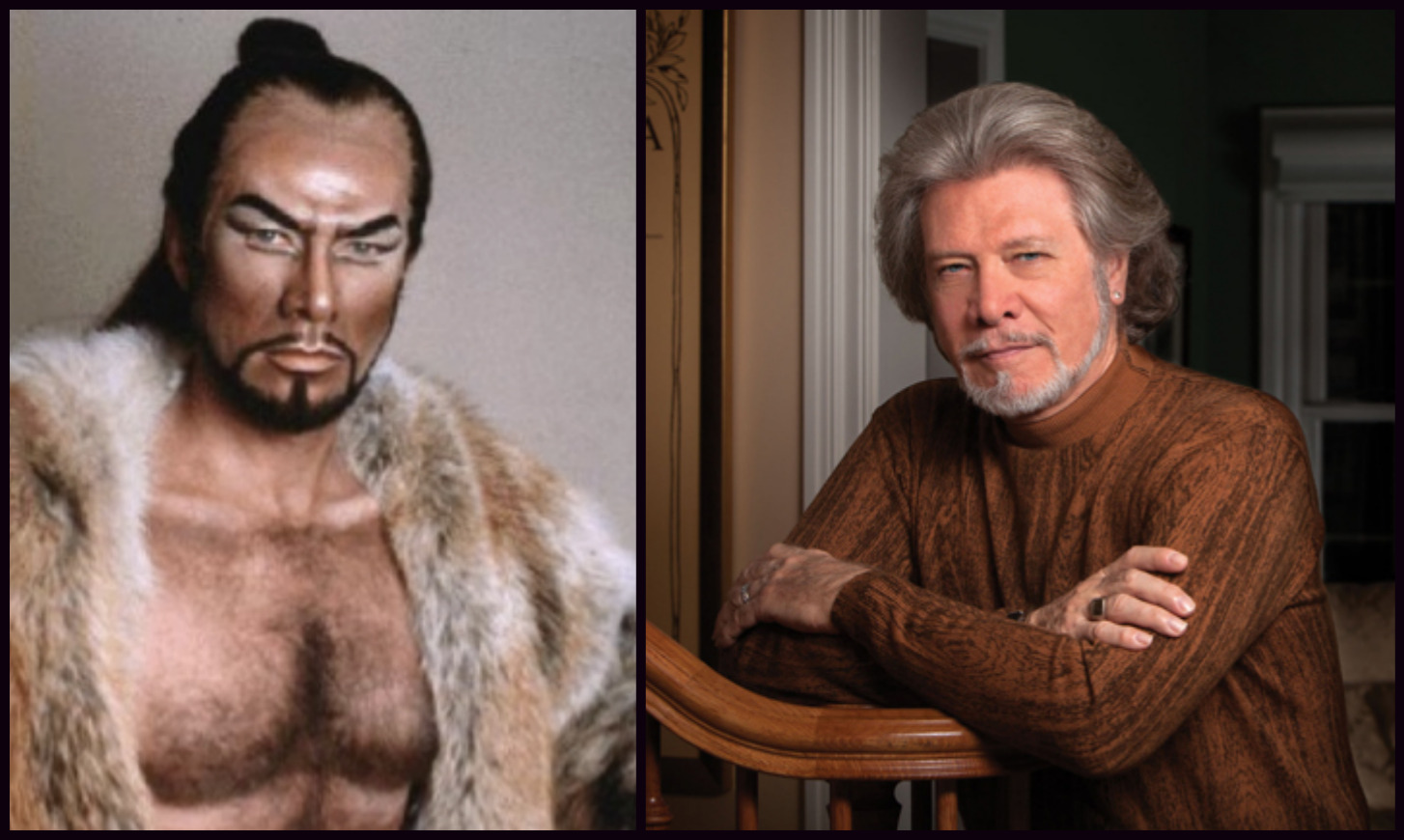
He has been referred to as the original barihunk by
some, for leading the way in sexy portrayals of the low voice repertory.
His video of Boito's Mefistofele
from the San Francisco Opera has become a cult classic with opera
aficionados. He continued his sexy shirtless portrayals as Attila
that were not only sexy, but set the vocal standard to this day.
His amazing vocal
flexibility and range has allowed his to sing roles ranging from Argante
in Handel’s Rinaldo to the title role in Bartok’s Bluebeard’s Castle. His
repertoire includes the florid pasages of Handel, the bel canto roles
of Bellini and Donizetti, the great baritone roles of Verdi and Puccini,
great American operas and even many of the great Russian and French
bass roles.
Rather than post our annual birthday tribute, we asked the legendary bass to answer a few questions for readers.
1. You were considered a "barihunk" before Francesca Zambello coined the
phrase, singing both Attila and Mefistofele shirtless. Did you ever
imagine that baritones and basses would become the sex symbols of opera?
Ramey: Generally speaking, most baritones and basses are "sexier" than most tenors. So I can‘t say I‘m surprised.
2. You're now singing two comprimario roles at the Dallas Opera. What
draws you to the stage when most singers are enjoying retirement?
Ramey: I feel that I still have something to offer as a performer and I still love being on the stage. I‘ve been trying to reinvent myself but it‘s not easy. I appreciate the Dallas Opéra for giving me this opportunity.
3. Your Attila and Mefistofele are considered definitive interpretations
by most opera aficionados. Were these your favorite roles. Which other
roles did you love?
Ramey: Attila and Mefistofele were certainly two of my favorite roles, but I have quite a few favorites. Others would be Mephistopheles in Faust and Damnation de Faust, Mozart‘s Figaro and Don Giovanni, Nick Shadow in Rake's Progress, Filippo II in Don Carlo, Bertram in Robert le Diable, Boris Godunov.
4. What role did you never get to sing that you would have loved to perform?
Ramey: I‘ve always loved the early Verdi operas. One I always hoped to sing was Silva in Ernani, but the opportunity never presented itself.
5. Karita Mattila just posted on our Twitter feed that Placido Domingo
was her best stage kiss. Who was yours?
Ramey: I didn‘t have many stage kiss opportunities but I‘d have to say that my best stage kiss was Marie McLaughlin.
Baritone Thomas Glass and bass William Guanbo Su are among the nine singers who advanced to the 65th annual Metropolitan Opera National Council
Auditions.
The 2019 Grand Finals concert will take place March 31.
Winners, selected by a panel of judges, will earn cash prizes of
$15,000, with remaining finalists receiving $7,500.
At the
recital, each finalist will perform two arias, accompanied by the Met
Orchestra (conducted by Carlo Rizzi).
Anthony Roth Costanzowill host the proceedings, which will also feature a performance from bass-barihunk Christian Van Horn. Tickets are available online.
The other finalists are tenor Piotr Buszewski, tenor Dashuai Chen, soprano Alaysha Fox, soprano Meghan Kasanders, tenor Miles Mykkanen, soprano Elena Villalón and mezzo-soprano Michaela Wolz.
A number of low male voices who won the Competition have gone on to have stellar international careers, including Louis Quilico, Justino Díaz, Robert Hale, Samuel Ramey, Thomas Hampson, Nathan Gunn, Eric Owens and Christian Van Horn.
Hannah Penn and Lee Gregory (Photo by Cory Weaver/Portland Opera)
Barihunk Lee Gregory, who starred in the Southern California premiere of Laura Kaminsky's opera "As One" at the Long Beach Opera in 2017, will reprise the role up the coast when he opens as "Hannah before" at the Portland Opera on March 22nd.
The world premiere of Laura Kaminsky's opera "As One," which
explores the revelatory and redemptive journey of a
transgender individual, opened on September 4, 2014 at the Brooklyn Academy
of Music with the real-life
married couple of mezzo-soprano
Sasha Cooke and barihunk Kelly Markgraf. The opera was a critical
success and has been performed throughout the country.
Joining Lee Gregory in Portland as "Hannah after" will be soprano Hannah Penn.
Performances will be on March 22, 24, 26, 28 and 30 and tickets are available online. There will be an extended Q&A after the Sunday, March 24th performance, which is free and open to the public.
Kaminsky was inspired to write As One after reading an article in
the
New York Times in 2008 about a New Jersey marriage in which one of the
parties transitioned from male to female, transforming the couple from
straight to gay. The opera is based on the life experience of noted
filmmaker
Kimberly Reed.
As One
provides insights into both the personal and philosophical questions at
the core of how personhood is defined, as well as into the compromised
civil and humans rights of transgender individuals in the broader
societal framework.
Baritone Robin Adams made his debut yesterday at the Staatsoper Stuttgart in the title role of Henze’s opera Der Prinz von Homburg.
The initial impetus for Henze’s Der Prinz von Homburg came from Italian director, Luchino Visconti, with whom the composer had worked with on the ballet Maratona di Danza in 1957. Henze asked Ingeborg Bachmann to adapt the libretto from Heinrich von Kleist’s play, Prinz Friedrich von Homburg oder die Schlacht bei Fehrbellin and the opera was premiered on May 22, 1960 in Hamburg. The text shows Henze's strong personal dislike of German militarism.
The opera begins with the eponymous Prince of Homburg who, having been distracted by a daydream before a major battle, misses the field marshal’s briefing and risks the army’s victory when he leads his troops into the fight. The battle is won nonetheless, but the prince is sentenced to death for disregarding orders. Der Prinz von Homburg explores the prince’s struggle with guilt and reconciliation, as well as the justice or injustice of his sentence.
Performance will run until May 4th and tickets and cast information is available online.
Henzes's operas can be seen at three other houses this year. Beginning in May with Der junge Lord at the Staatstheater am Gärtnerplatz in Munich and his final opera Phaedra at the Royal Opera House in London featuring the Jette Parker Young Artists. In July, a new production of the Elegy for Young Lovers will open at Theater Aachen.
Vittorio Prato will make both his role debut and house debut when he steps on the stage this week at the Hamburg State Opera.
He'll be singing the role of Lescaut in Puccini's opera Manon Lescaut, led by the stunning soprano Kristine Opolais in the title role and tenor Jorge de León as Des Grieux. Performance are on March 21 and 29 and tickets are available online.
Puccini's libretto is an amalgam of text by five different librettists whom Puccini employed, including the composer Ruggero Leoncavallo, as well as Marco Praga, Giuseppe Giacosa, Domenico Oliva and Luigi Illica. The opera was composed between 1890 and 1893 and is based on the 1731 novel L'histoire du chevalier des Grieux et de Manon Lescaut by the Abbé Prévost. It was the composer's third opera and his first big success.
Australian barihunk Damien Pass (whose birthday is today), is taking on the role of Oberlin in Wolfgang Rihm's one act chamber opera Jakob Lenz at the Festival le Balcon at the Athénée Théâtre Louis-Jouvet in Paris. The title role is being sung by Vincent Vantyghem, as regular with Maxime Pascal’s contemporary Ensemble Le Balcon. Vantyghem has also sung the role at the Dialogues Festival in Salzburg.
The opera runs through March 29th and tickets are available online.
The opera was first performed at the Hamburg Staatsoper in 1979 with the late English baritone Richard Salter in the title role. It has subsequently been performed at the Wiener Festwochen and at Oper Stuttgart with Georg Nigl, Teatro Comunale di Bolgna with Tomas Möwes, Theater Bielefeld with Evgueniy Alexiev and at the English National Opera with Andrew Shore.
The opera Jakob Lenzis based on the novella "Lenz"
by Georg Büchner which deals with an incident in the life of the German
poet. Lenz, who along with Johann Wolfgang von Goethe, formed the “Sturm und Drang” (Storm and
Stress) movement in German literature which made German authors the
cultural leaders of Europe during the 18th century.
The source of Büchner's material comes from the diaries of the
social reformer and priest Johann Friedrich Oberlin, which detail the
activities of his house guest, who was clearly suffering from mental
illness at the time. The
suicidal poet stayed with Oberlin in a small village in the Vosges
Mountains near the German-French border in the hope of recovering from
his depression.
Büchner's
opening pages describing the mountain landscape and hinting at Lenz's
inner state with the single sentence "he did not feel at all tired, only
it sometimes annoyed him that he could not walk on his hands instead of
his feet" are reduced to a stage direction, but the rest of the
libretto roughly follows Büchner's outline. A key element of thelibretto deals with his trauma around the death of a small child whom was he was
unable to resuscitate. At the end of Lenz's life he lived with Goethe's brother-in-law, Johann Georg Schlosser, where he lived in poverty. After years of increasingly poor physical health and
debilitating mental problems, Lenz died on the streets of Moscow 1792.